












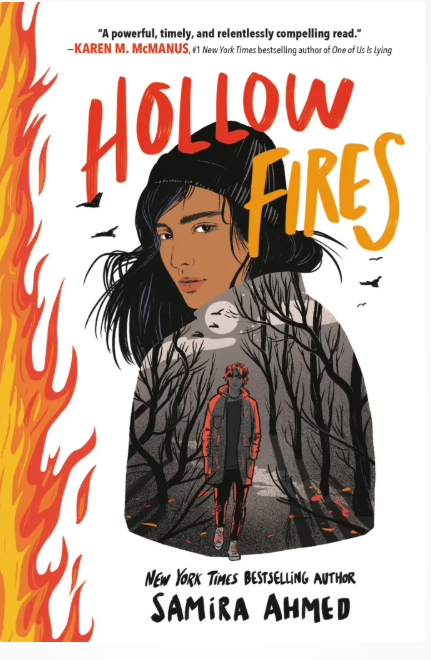


Hollow Fires is a book that follows Safiya Mirza, a 17-year-old high school journalist in Chicago, who discovers the murdered body of Jawad Ali Jawad was arrested months earlier after his homemade cosplay jetpack was mistaken for a bomb by his English teacher. After being unfairly labeled a terrorist and targeted by online hate, Jawad disappeared. After being driven by a haunting ghostly voice that only she can hear, Safiya is determined to expose the conspiracy surrounding his murder. The story is told in alternating perspectives between Safiya’s investigation and Jawad’s posthumous commentary. The narrative also features inserted documents, such as news articles, social media posts, and interview transcripts, to create a realistic account of the events.
Samira Ahmed, author of Hollow Fires, was inspired by real-life events, particularly the story of Ahmed Mohamed (the “Clock Boy”), and a broader concern for the erasure of people of color in media, especially Black, Indigenous, and Muslim youth, fueling her desire to give voice to the forgotten victims of hate and bias, blending thriller elements with themes of journalism, racism, and Islamophobia.
The book introduces a challenging yet compelling narrative, which I found to be a demanding read due to its explicit engagement with providing real-world social crises. The author unflinchingly incorporates difficult subjects such as racism, Islamophobia, and white supremacy directly into the core of the storyline.
Despite the intensity of these themes, they serve to ground the novel in a harsh reality, making it a powerful experience for those prepared to confront these topics. The narrative masterfully weaves these serious issues into a gripping plot.
I would strongly recommend this book to readers who appreciate the genre of murder mystery but are also seeking a story with significant depth and social commentary. It is particularly suited for those interested in exploring themes of systemic racism, Islamophobia, and the powerful, often biased, role of media in contemporary society. The book successfully uses the framework of a mystery to shed light on these critical societal issues.