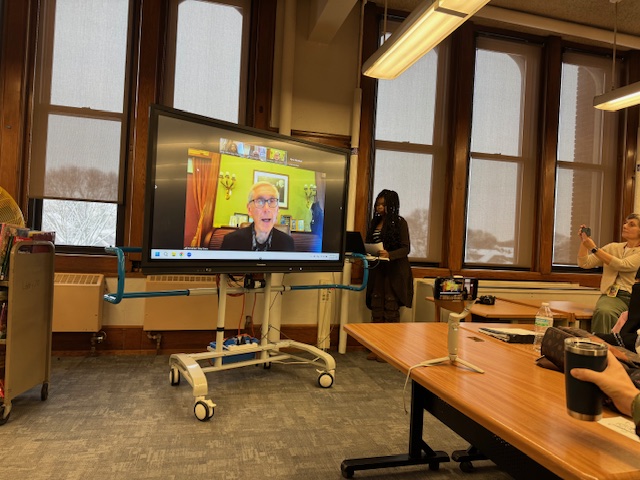

As Milwaukee faces the growing concern around interruption in federal Supplemental Nutritional Assistance Program (SNAP) funding, local leaders are turning to schools and students to help support families in need of food. Milwaukee Public Schools (MPS), the largest district in the state, has become a central partner in coordinating food donation, spreading information, and ensuring that young people and their families know where to turn for help.
Both Mayor Cavalier Johnson and County Executive David Crowley emphasised the essential role students can play in strengthening Milwaukee during this difficult time for people of Wisconsin. Mayor Johnson explained that Milwaukee public schools have always been more than an educational institution; they’re a vital support system for students and their families. Here is what Mayor Cavalier Johnson further said, “In my interaction with Superintendent Brenda Cassellius, we have mutually agreed to work collaboratively on a wide range of topics. As a community partner, MPS will be a location for donations and advocate for support as Milwaukee navigates the interruption in SNAP funding. It is important to note that MPS plays a huge role in feeding young residents through meal programs at all its schools.”
County Executive David Crowley echoed this emphasis on partnership, stressing the unique reach MPS has across the city. “Like all school districts in Milwaukee County, Milwaukee Public Schools is one of our most important partners,” Crowley mentioned. “MPS serves thousands of students across the city, many of whom rely on consistent access to meals that may be impacted by the federal government shutdown. By partnering with MPS, Milwaukee County, and the city of Milwaukee are continuing to work to make sure students and their families have the support and information they need about local food resources and are here to access assistance.”
Both leaders agreed that students are not just bystanders; they are essential to the success of this community-wide effort. “Students can play important roles,” Mayor Johnson said, “if circumstances allow, they can donate food. They can also provide voices to alert the entire city of the urgent need to support the agencies that address hunger, such as Feed America Eastern Wisconsin.
The Milwaukee Public School was reached by the Milwaukee health department about the food drive. As soon as they were aware of SNAP benefits being delayed for Wisconsin residents, they immediately recognized the need for action on the part of the local government. This helped them to decide to say yes to both collecting food and participating in the announcement about the food drive. According to Anthony Tagliavia, Milwaukee Public Schools’ Chief Communications Officer, “No one should go hungry. We are grateful for anyone in our community who steps up to support those in need- and we recognize that some of our students, families, and staff are among those in greatest need.” Milwaukee Public Schools agreed to serve as a donation site for community members to donate their non-perishable food items to the drive. They did this by providing large donation boxes to schools.
Crowley emphasized that students have real power to make a difference, no matter their age or background. “High school students and school organizations have the power to make an impact,” Crowley stated. He encouraged organizations, including high school athletics and extracurricular groups, to give monetary contributions, to raise awareness, to volunteer in neighbourhoods, and to package food boxes to deliver to families and people in need.
One of the most important tools in helping families is simply making sure they know where to go for help. Mayor Johnson highlighted one key resource. “One important way for students and organizations to get involved is to spread vital information about resources that are available to people in need,” Johnson further stated. “The most important messages to connect people with impact 211. I do not want people to suffer in silence because they do not know where to ask for help.”
Crowley added that awareness could be lifesaving for the vulnerable residents of Milwaukee. “Use school announcements and social media to ensure your friends and neighbours know where they can receive support, especially for our older adults who may have difficulty accessing information,” Crowley mentioned.
Both Johnson and Crowley reflected on how their own experience growing up in Milwaukee shaped their commitment to community service. “One thing I learned as a student at Bay View is that, together, as a community, we are positioned to solve the challenges we face, ” Johnson said. “As a teenager, I found volunteering to be a reward… and that led to my career path in public service and ultimately, elective office. Volunteering makes Milwaukee a stronger city.”
Crowley shared that his connection to food insecurity is deeply personal. “I grew up in Milwaukee, and my family dealt with both food and housing insecurity, so I understand what it feels like to worry about basic needs. He said, “That experience taught me that a community is strongest when we take care of one another. At the end of the day, I believe food is a human right.”
Both leaders ultimately delivered the same message: students are not the future leaders of Milwaukee; they are leaders right now. “Together, as a community, we are best positioned to solve the challenges we face,” Mayor Johnson emphasised. Crowley closed with a similar message of empowerment for Milwaukee’s youth. “Challenging times can make you feel powerless, but they also reveal how powerful a community can be when people step in and step up,” he said. “Don’t underestimate the impact you can have right where you are. Small actions can make a big difference, and I believe in you.”